The Paris Agreement: Limiting Global Warming
Global concern about climate change gained momentum in the 1990s, when it became clear that the increase in greenhouse gas (GHG) emissions was related to global warming.
In this context, the United Nations Framework Convention on Climate Change (UNFCCC) was created during the United Nations Conference on Environment and Development (also known as Rio-92) establishing the legal basis for international cooperation in combating climate change.
Since then, one of the greatest advances achieved in this direction was the Paris Agreement. Signed in 2015, during the 21st Conference of the Parties (COP21), it brings together developed and developing countries in a commitment to limit the increase in the average global temperature to 2°C, with efforts aimed at up to 1.5°C, in relation to pre-industrial levels.
After this, countries began to establish and present their commitments to reduce GHG emissions, called nationally determined contributions or NDCs.
The most recent Brazilian NDC was submitted to the UN in 2024 and established a commitment to reduce Brazil’s net GHG emissions 59% to 67% by 2035, using 2005 as a baseline, in addition to reaffirming the goal of achieving climate neutrality by 2050.
What is climate neutrality?
Achieving climate neutrality means reaching net-zero GHG emissions by balancing what is emitted into and removed from the atmosphere.
Combating deforestation, promoting renewable energy, restoring forests, and transitioning to a low-carbon economy are fundamental to reaching these goals. The BNDES has been working towards this objective, for example, through the operationalization of reimbursable resources from the National Climate Fund, connected to the Ministry of Environment and Climate Change (MMA).
How are avoided and removed emissions calculated?
The BNDES uses its own calculators for measuring GHG emissions avoided or removed, and makes them widely available.
In addition to being used to measure the result of projects supported with resources from the Climate Fund, these tools are also used to calculate the Bank’s inventory of avoided and removed GHG emissions, published annually along with the methodologies applied, reinforcing its pioneering and transparent role in the promotion of sustainable development.
What does avoiding greenhouse gas emissions mean?
Avoiding means preventing the emissions that would occur in a more polluting reference scenario. A project avoids emissions when it promotes the replacement of a GHG-intensive activity or technology with a lower-carbon-intensive alternative. Examples include wind power generation as a replacement for coal-fired power plants or the use of biofuels instead of diesel and gasoline.
What does removing greenhouse gas emissions mean?
Removing GHG emissions means reducing the atmospheric concentration of gases already emitted. This results from the process of removing already emitted greenhouse gases from the atmosphere, either through biological mechanisms, such as carbon sequestration from forest growth, or through technological solutions, such as carbon capture and storage (CCS) systems.
Avoided or removed emissions are calculated from the difference between the estimated values in the scenario where the project under analysis is conducted and in the baseline scenario (without the project). Each module of the calculators considers specific characteristics of each type of project.
The module relating to the production of biofuel for use for transportation, for example, calculates the GHG emissions avoided by replacing the consumption of fossil fuels with the consumption of biofuels.
The inventory process involves annual calculations of the tons of CO₂ equivalent (tCO2e) avoided or removed by different types of projects (renewable energy, transport, biofuels, forests, etc.) financed directly by the Bank. In addition to the positive impact of these projects, the BNDES also publishes annually the inventory of the emissions resulting from the projects it supports, i.e., the carbon footprint of the operations in its direct credit and equity investment portfolio, as well as the inventory of its administrative emissions, reinforcing its commitment to transparency and responsible climate management.
What is a ton of carbon equivalent?
A ton of carbon equivalent (tCO2e) is a unit of measurement used to standardize emissions of all different types of GHGs, converting them into a value equivalent to that of carbon dioxide (CO2). For example, methane (CH4) has a global warming potential (GWP) 28 times greater than that of CO2. That is, the emission of one ton of methane is equivalent to the impact of 28 tons of carbon dioxide.
The calculations of avoided and removed emissions are published for transparency in aggregate form on specific sections on climate change on the website by segments of the BNDES portfolio.
Below the result of the emissions inventory. The annual inventory presents the amount of GHG removed or avoided by the project over a year.
GHG Emissions Avoided
|
Sector
|
Emissions avoided (tCO2e)
|
|
Biogas capture and energy recovery
|
7,994,758
|
|
Implementation and operation of power generation plants from solar sources (photovoltaic or thermal), ocean energy (tidal, wave and other), wind or micro-hydro generation (without large hydroelectric plants)
|
9,596,931
|
|
Large hydroelectric plants
|
14,899,347
|
|
Acquisition of photovoltaic cell modules, small wind turbines, and biogas engines
|
730
|
|
Urban passenger rail transport
|
92,538
|
|
Support for bus rapid transit (BRT) project modules
|
2,131
|
|
Biofuel production for use in transport operations
|
3,032,923
|
|
Rail and waterway freight transport
|
105,327
|
|
Sustainable charcoal production
|
10,416
|
|
Total
|
35,735.101
|
GHG Emissions Removed by Projects Financed by the BNDES – 2024
|
Sector
|
Emissions removed (tCO2e)
|
|
Restoration of biomes
|
15,074
|
|
Forest planting with commercial species
|
9,273,325
|
|
Total
|
9,288,399
|
Note: The inventory considers emissions avoided and removed from contracted operations already in progress, with an unpaid balance greater than zero, with the potential to avoid or remove GHG emissions. In the case of projects that do not have calculation methodologies within the scope of the calculators used by the Bank, but which must present an estimate of GHG emissions avoided or removed, the calculations may be presented by the owner of the operation, certified by an independent third party.
The BNDES is a pioneer in the annual publication of an inventory of GHG emissions avoided and removed by the entire portfolio of mitigation projects (not just from specific sectors or projects). In addition to publishing the figures from the most recent inventory, the Bank also publishes reports, detailed methodologies, and inventories from previous years.
Importance of the Climate Fund in the climate change context
The Climate Fund was established in 2009, in the context of COP15, and is the main financial instrument of the Brazilian National Policy on Climate Change (PNMC) and one of the most relevant funding source for climate financing in Brazil enabling projects that contribute directly to mitigating and adapting to climate change.
Originally, the main sources of resources of the Climate Fund are the special participation due to the Federal Government in the exploration of oil, natural gas and other fluid hydrocarbons, the return of the income from the investments of available funds, and the interest and amortization payments on loans made with resources from the Fund.
In 2023, the Brazilian government made the first issue of sovereign sustainable bonds, from which new resources were allocated to the Climate Fund, which significantly increased its operation scale.
From 2024 onwards, with the expansion of these new resources provided by the Federal Government, it will become the largest mechanism to support green financing in a country in the Global South. The amount approved by the Climate Fund in 2024 represents 75% of the total approved during the same period by the Green Climate Fund (GCF), which was established by the UN and is the largest multilateral climate finance fund currently in operation.
The Climate Fund’s project approvals between 2013 and 2023 totalled R$ 3 billion (end-of-2024 prices updated by the IPCA). In 2024, the first year of the inflow of new resources from the issuance of sovereign sustainable bonds, R$ 10.2 billion were approved, showing the potential that this financial instrument has gained in combating the climate crisis.
The expansion of the Climate Fund and its operation by the BNDES represent a robust institutional architecture placed at the service of Brazilian society and the global effort to mitigate and adapt to climate change.
The BNDES participates in the operation of the Climate Fund as its financial agent, conducting the operations of reimbursable resources of the fund, both directly and indirectly through financial agents duly registered for this purpose.
Emissions avoided or removed by Climate Fund projects
The contribution of projects financed by the Climate Fund to mitigate the effects of climate change is evaluated by the Bank through its calculators. Based on these tools, it is estimated that the operations approved in 2024 with resources from the fund will avoid or remove, on average, 4.0 million tCO2e per year. This amount is equivalent to nine months of emissions from cars in the metropolitan area of the city of São Paulo. The Climate Fund’s reports also provide information on emissions avoided throughout the lifespan of the projects. It should be noted that many of the operations approved in 2024 were not included in the inventory of avoided or removed emissions from the BNDES portfolio, as they are still in the contracting or project implementation phase. This means that the potential positive impact of the fund in the year the inventory is published is not fully reflected, as this will only occur when the projects begin operating.
How do other banks present the calculation of avoided and removed emissions?
The table below compares the methodology for calculating avoided emissions from projects financed by the Climate Fund with the information available from four other funds or institutions that support climate mitigation.
Transparency of calculations of avoided/removed emissions from climate funds
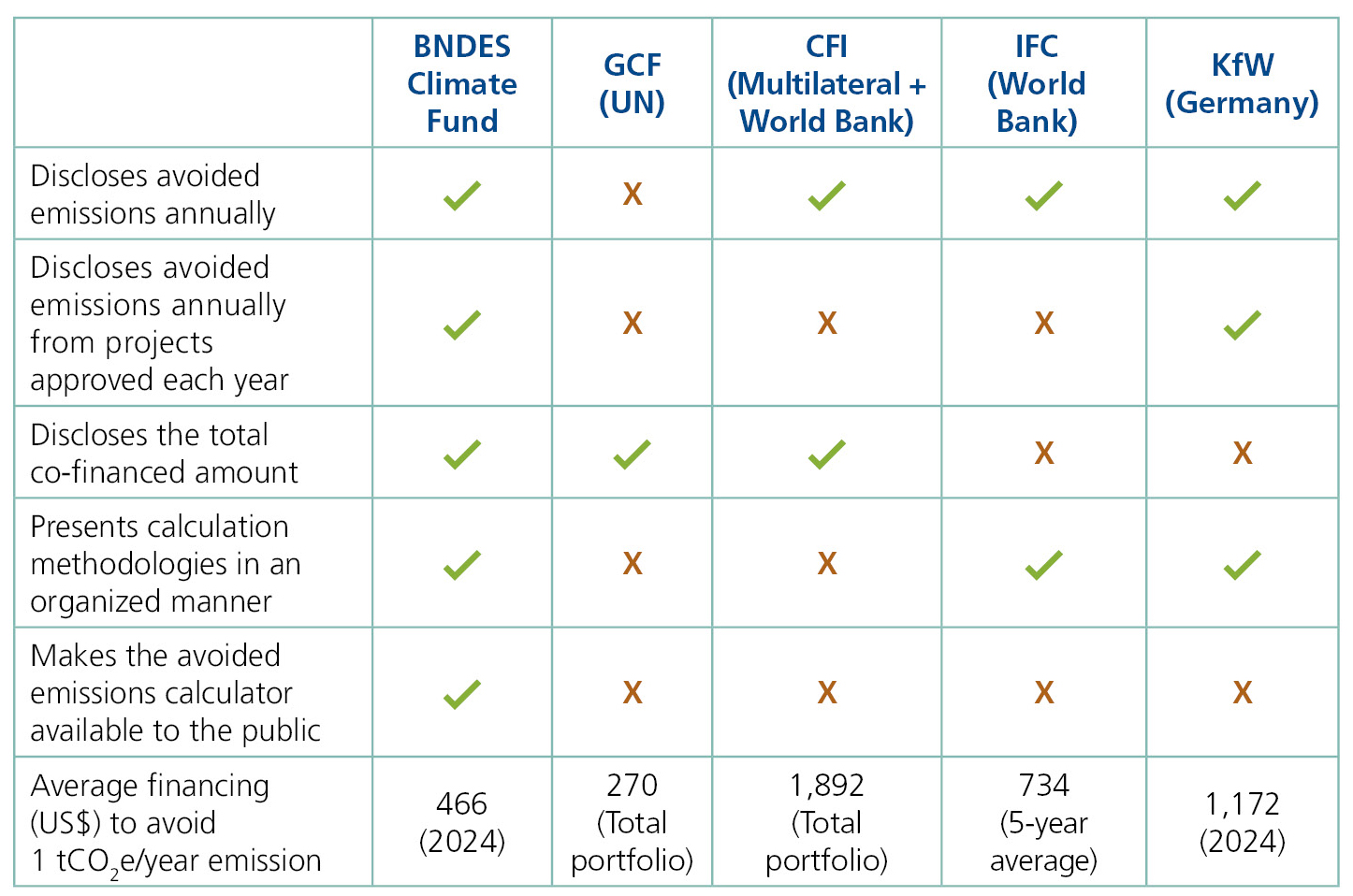
Source: Elaborated by the authors. Note: GCF: Green Climate Fund; CIF: Climate Investment Funds; IFC: International Finance Corporation; KfW: Kreditanstalt für Wiederaufbau.
Only the Climate Fund and KfW (German development bank) simultaneously present the financed amounts and avoided emissions of approved projects on an annual basis, allowing for a timelier assessment of the contribution of financing to mitigation.
The Green Climate Fund presents the avoided emissions of projects cumulatively, based on the lifespan criterion. The Climate Investment Funds (CIF), managed by the World Bank and whose funding consists of donations and loans from developed countries, presents in its 2024 annual report the emissions avoided or reduced annually from its portfolio, i.e., from the stock of projects approved over the years.
Finally, the International Finance Corporation (IFC), a World Bank group institution with a focus on climate finance, only discloses the values of avoided emissions accumulated over five years.
In terms of the value of financing per tCO2e, the Climate Fund is the most efficient, with the exception of the GCF. However, the information for calculating avoided and removed tCO2e emissions was not found in full on the GCF website. The amount of funding is disclosed.