The climate crisis has led governments to work towards expanding productive decarbonization and environmental preservation. These two agendas are related to the strengthening of sustainable development and the expanding of financial markets for green investments, relevant trends of the last decade.
The BNDES has a long experience in sustainable development and has been expanding and diversifying its sources of funding with a focus on environmental sustainability, the so-called green funding.
The BNDES’s history in environmental sustainability
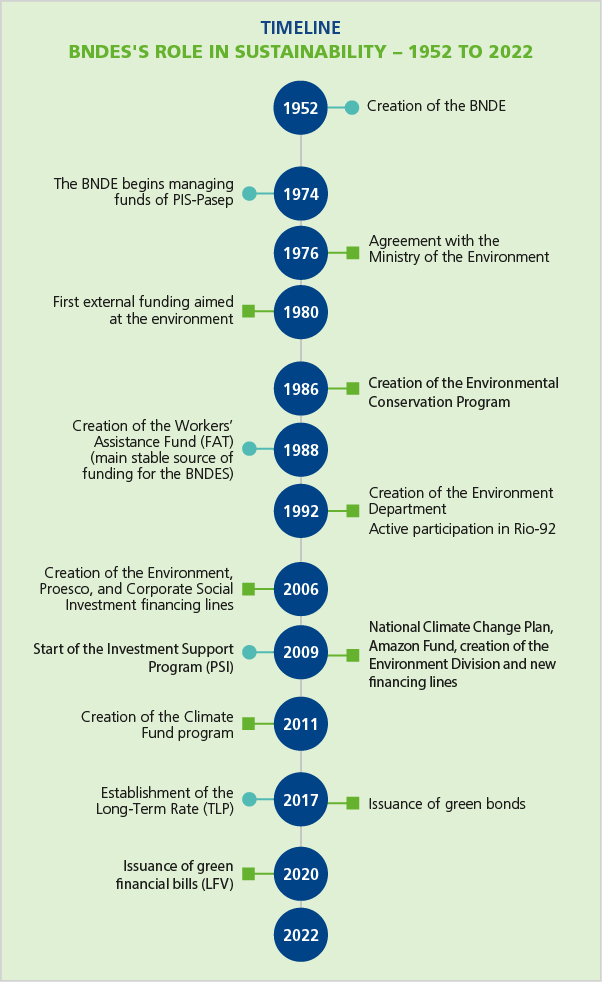
In the mid-1970s, the BNDES began the inclusion of the environmental agenda in its core activities with the establishment of an agreement with the Brazilian Secretariat for the Environment.
In 1980, the Bank conducted its first external fundraising with focus on the environment, with the International Bank for Reconstruction and Development (IBRD) for pollution control.
Later, in 1986, the Bank created the Environment Conservation Program; in 1992, the Environment Department was established, the first in a Brazilian bank; and finally, in 2006, specific financing lines for social and environmental investments were launched.
Since then, several programs and protocols have been created. The National Program for Climate Change was established in 2009, associated to the launch of the Amazon Fund and the creation of the Climate Fund. The Amazon Fund receives international donations for the application of non-reimbursable resources in the conservation and sustainable use of the Amazon and is managed by the Bank, while the Climate Fund’s reimbursable resources are operated by the BNDES. Both funds are coordinated by the Ministry of the Environment and were the first stable sources of funding of the BNDES directed to environmental issues, even though they represented very small portions of the institution’s assets until recent years.
After 2009, the Bank raised market funds for environmental purposes. In 2017, the BNDES was the first Brazilian bank to make an international issuance of green bonds, raising US$1 billion, with a seven-year term and a return rate of 4.8% p.a. on the Luxembourg Green Exchange. In 2020, the Bank was the first to launch green financial letters in the domestic market, raising R$1 billion with two-year term bonds aimed at wind and solar energy projects.
Thus, we can see that since the 2008 crisis lines of credit and disbursements related to sustainable development have expanded, and the first sources of funding for this purpose have emerged. The BNDES pioneered the consensus on sustainable development, which was only consolidated internationally with the 2030 Agenda launched by the UN in 2015.
After years of reduced environmental activity, between 2016 and 2022, the Bank resumed this agenda from 2023 onwards, quickly becoming a leader in some areas. It stands out, for example, as the Bank with most investments in renewable energy in the world.
Green Funding at the BNDES
Since 2023, in order to expand its historical level of activity, the BNDES has been diversifying its sources of funding, given the restrictions on expanding financing through the Workers’ Support Fund (FAT).
This diversification of funding sources and the internal restructuring to deal with recent crises (social, climate and trade) reflect the new strategic orientation, which was called the “New BNDES” by Barbosa, Aidar and Souza. In addition, environmental and social agendas have gained new prominence and have become cross-cutting in the Bank’s activities.
This strategy aligns with the international agenda for containing the climate crisis, which has gained momentum since 2015 with the 2030 Agenda and the Paris Agreement.
In this context, green funding is a fundamental resource for expanding the Bank’s activities in green economy and social development, as well as serving as a diversification of funding sources.
The capital raised in the international market has become a significant new source of funds. In 2024, the country raised R$ 10.4 billion through the Climate Fund in the form of sustainable sovereign bonds issued by the National Treasury. In the first half of 2025, the Treasury raised another R$ 10.9 billion, which was transferred to the BNDES. With these two contributions, at the end of the first half of 2025, the BNDES’s assets related to the Climate Fund reached R$ 24.8 billion.
In addition to the Climate Fund, external fundraising with international institutions and the Amazon Fund deserve mention. Almost suspended between 2018 and 2022, the donations were resumed in 2023, reaching at the end of the first semester of 2025 a volume of of around R$ 35.7 billion from international organizations and multilateral institutions, of which R$ 28.8 billion (80.6%) depended on investments in sustainable development.
These external fundraising actions serve as a source of diversification for the Bank’s funding. Some of them have guarantees from the Union and, in June 2025, had a weighted average interest rate of 5.9% p.a., below the Brazilian market and similar to that of the Climate Fund.
The BNDES has current contracts for R$ 65.8 billion in external resources for sustainable development, with most of them (R$ 40.9 billion) having been signed between 2023 and the first half of 2025. The volume of recent contracts signals the growing weight of this financing mechanism. The difference between the contracted amount and the amount disbursed is due to the disbursement schedule of the contracted operations.
Finally, donations to the Amazon Fund were also resumed from 2023 onwards – after a period of suspension of the analysis of new projects due to the dissolution of the fund's governance structure. With the restructuring of its governance and the new administration of the Bank, the fund started receiving donations again, and its resources increased from R$ 4 billion at the end of 2022 to R$ 6.1 billion in June 2025.
Agreements with international institutions and multilateral organisations aimed at sustainable development
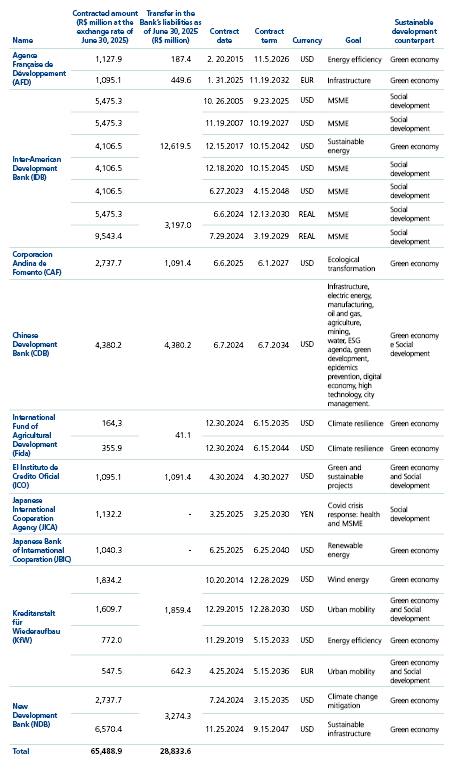
Source: Individual and consolidated financial statements from the BNDES as of June 30, 2025, and data from current contracts from the BNDES.
Notes: 1. The loans are in foreign currency and the value in reais was calculated based on the exchange rate of June 30, 2025. 2. Following the official methodology presented on the BNDES portal, “green economy” includes activities promoting renewable and hydroelectric energy; decarbonisation of passenger and freight transport; water, sewage and solid waste management; forest management, reforestation and forest preservation; sustainable agriculture; and adaptation to climate change and disaster risk management. “Social development” includes health; education; productive inclusion; public management; urban development with activities such as environmental sanitation and public transport; and incentives for corporate social responsibility.
Adding up the external funding from foreign institutions with a sustainable focus, from the Climate Fund and the Amazon Fund, the BNDES had R$ 59.8 billion in sustainable funding in its assets at the end of the first half of 2025 – a volume equivalent to 8.4% and 6.7% of the Bank’s total assets and funding, respectively. The total inflow from the three sources in the last three semesters was approximately R$ 37.9 billion, that is, 25.4% of the net inflow of resources in the period and 45.2% of the net inflow if FAT resources are excluded.
This type of funding is still relevant due to its incentivized and/or non-reimbursable nature, which reinforces its inductive potential, as it opens up space for the design of incentives to mobilize private capital for the BNDES’s environmental and strategic activities.
The use of green funding should increase, given Brazil’s environmental potential and its incentivised cost, which makes it possible to establish the green economy as a fundamental part of our development model.
On the other hand, dependence on external sources for these investments poses risks related to external imbalances and geopolitical changes, so it is crucial to analyse potential domestic and incentivised sources of resources for sustainable development, as they may become fundamental to enabling investments in the climate agenda.