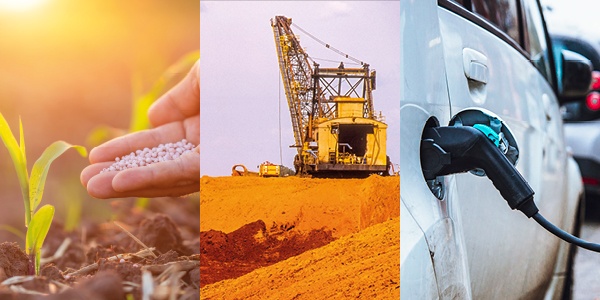
On March 10 and 11, 2025, BNDES hosted an international conference on Strategic Minerals Value Chains for Energy Transition and Decarbonization. The event was attended by Constantine Karayannopoulos, an expert in the rare earth and critical minerals industry. He talked to us about Brazil's potential in this context and possible paths for the country to consolidate itself as a relevant player in this market. Full interview below.
1. Global warming is a reality and decarbonization a necessity. What is the relevance of rare earth elements and their processing in this context?
1.a. Rare Earths play a key role on both sides of the Energy/Decarbonization equation (energy generation and energy utilization). Wind Power is one of the key forms of renewable energy generation. Rare Earths magnets are used in the generators that convert kinetic/rotational energy of the turbine to electric power. Particularly in offshore wind turbines, the newer, larger designs have 2-5 tonnes of rare earth magnets embedded in the stator around their turbine rotors. This improve the energy conversion efficiency and minimizes maintenance, which is a significant cost for off shore wind power.
1.b. A large portion of the energy generated in the world is used by internal combustion engines and motors of all kinds and sizes. The transition to electric vehicles needs electric motors to replace the ICE engines. The most energy efficient EV traction motors (the motors that turn the drive wheels) are the ones using Rare Earth magnets. RE magnet motors tend to be smaller, lighter and need less energy to perform the same task as non-RE magnet motors.
Many other motors (such as motors in water pumps and fuel pumps) can achieve higher energy efficiency by utilizing RE magnets.
2. Recently, in a talk at the BNDES, you mentioned that today China is responsible for most of the processing of rare earth elements globally. What role has industrial policy played in the Chinese case, and what role could it play in Brazil?
2.a As I mentioned in my comments, the Chinese government identified the energy transition and the related markets (such as EV) as priorities 15-20 years ago. It then proceeded along four parallel strategies: (i) secure the critical raw materials that were required to feed into the related supply chains (REs, Lithium, Cobalt, Nickel, Copper…), both in China and abroad (ii) nurture and support promising startups (such as BYD in EVs and CATL in batteries) throughout the supply chain until they reached critical mass and became world leaders in their field, thereby creating the demand that drives production through the supply chain; this support has taken the form of easy access to capital for investment in China and abroad, low cost of capital and preferential contracts when governments buy EVs and batteries. Other measures have included the establishment of free trade zones and industrial parks that have facilitated the creation of specialized ecosystems (iii) Use regulation (such as driver/owner permits) at the consumer level to influence choices towards EVs and away from ICEs. (iv) Invested heavily in education and innovation; a number of institutes around China are world leaders in technology development in the processing and applications of critical minerals. These developments are transferred to companies in the supply chain at no cost or a very modest licensing fee. Chinese universities graduate the largest number of engineers and scientists in the critical minerals field. For example, there are 39 university department dedicated to Rare Earth education.
2.b As I said in my comments at the conference, Brazil can pursue a similar strategy. Since it has all the primary critical materials, first, Brazil needs to ensure the survival, nurturing and success of the emerging raw material producers. Second, it needs to establish the regulatory conditions and framework to attract and incentivize the establishment of supply chain participants. This will create demand for the products of the emerging raw material producers as well as create an ecosystem for the further development of these industries.
3. It is said Brazil has an opportunity to emerge as player in the market of rare earth magnets and, consequently, in industries that rely on them, such as electric vehicles. The country sits atop the natural resources necessary, with abundance of good quality iconic clays that are a source of this rare elements. However, that is not enough to guarantee a positive outcome. Based on the experiences of Europe and China in this area, what would you say are some of the steps Brazil should take in order to make this possibility a reality?
3.a The potential is definitely there. Ultimately, however, the success of Brazil’s industrial strategy will depend on Brazil’s ability to create demand for value-added rare earth products such as magnets. So it needs to create the regulatory (tax and currency management, primarily) conditions and framework to attract investment through the supply chain. Industrial strategy is a long term tool (in decades, not election cycles) and it needs agreement across the political spectrum. Brazil needs to start conversations with key automotive and wind power participants to attract production to Brazil. They will then attract their suppliers to invest locally in order to achieve “local for local” supply chain resiliency. At the same time, Brazil needs to work with universities as well as consolidate and reorganize key R&D institutes to focus on the development of technology and skills that can then be adopted by the emerging producers.
3.b ESG is still a large concern in most advanced markets in the world. The large automakers and their suppliers put a great deal of emphasis on Life Cycle Assessments (LCA), Carbon footprints and environmental practices. One of their key concerns is the origin of most of the heavy REs used in magnets for EVs today, which originate in Myanmar. Brazil has the opportunity to emerge as a leading ESG source of REs and products using REs with world leading ESG principles. Environmental regulation and enforcement, therefore, needs to be a central pillar of any strategy Brazil adopts.
4. How can the government and the BNDES (the Brazilian development bank) help in this transition and, from your perspective, are there already qualified players (researchers, companies etc.) that can take part in Brazil’s transition from a raw material supplier to a producer of value-added products?
4a. There should be at least four areas of focus for this transition:
- Financing for emerging producers: BNDES has had a good start with the creation of a public/private fund to invest in the industry as well as the start of discussions with international ECAs. Most of the advanced economies (G7, the EU) recognize the importance of critical minerals to their economies and have mandated their respective ECAs to facilitate the establishment of new supply alternatives. Japan has been particularly active in this field as it provided critical financing to Lynas through METI, JOCMEG, JBIC and its large trading companies as Lynas was emerging as a RE miner (in Australia) and refiner (in Malaysia).
- Innovation and Education: Bring universities and research institutes together for the development of key processing technologies and skills that can support the emerging producers and new producers through the supply chain. IPT, CETEM, CIT SENAI ITR, UFSC Magma, SENAI PARANÁ are a good start. Their work needs to be coordinated and they need to collaborate. This activity can also greatly benefit from collaborating with universities and institutes abroad.
- Regulatory framework: Following the examples of China and the EU, capital grants, operating incentives, a favourable tax regime, the establishment of free trade zones for export-focused manufacturing (in the case of China), the Critical Raw Materials Act and the Battery Alliance (EU), the IRA (US) and consumer regulations that helped created and drive domestic demand are some of the tools that have been used successfully in China, the EU and the US. Brazil can adopt and adjust these tools to reflect the Brazilian reality.
- Demand: While creating domestic demand and a capable critical minerals ecosystem, Brazil should also focus on export markets, both international (North America, the EU, Japan, Korea) and regional (South America). This will provide the ultimate economic opportunity to attract long term investment and production in Brazil. The international automakers who have presence in Brazil as well as their Tier-1 drivetrain suppliers (some of whom also have operations in Brazil) and battery producers would be the first targets to approach.
Of course, these ideas need longer study and more thoughtful analysis. Not everything that has worked in other jurisdictions will necessarily succeed in Brazil. The tools need to be customized for the Brazilian culture and political environment. The conversation, however, needs to start now as it will take at least a decade to implement this type of strategy. It will take money, time and hard, smart work to succeed.
 |
|
Constantine Karayannopoulos is a professional engineer with a Bachelor and Master of Applied Science degrees in Chemical Engineering from the University of Toronto. He is a member of the advisory board of Lithium Royalty Corp., of the University of Toronto’s Department of Chemical Engineering and of the Canada China Business Council. He is currently a strategic advisor to several public companies in the rare earth and critical minerals industry. He was a co-founder of, and has held numerous senior executive positions in, Neo Performance Materials prior to his retirement – such as President, Chief Executive Officer, Chairman and Director –, and was one of the founders as well as non-executive Chairman of the Board of Neo Lithium Corp.
|