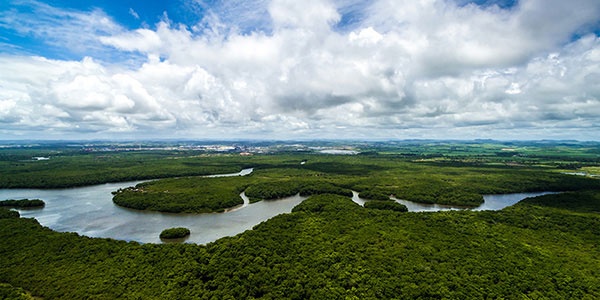
Brazil currently has a total of 2,446 conservation units, including federal, state, and municipal units, covering approximately 18% of the country’s continental territory and 26% of its marine areas [1]. These units are divided into two main types —strict protection and sustainable use— and further subdivided into 12 different categories.
The history and role of conservation units
The creation of restricted areas focused on preservation originally aimed to conserve natural environments with exceptional characteristics, including specimens of their flora and fauna. The first milestone in the establishment of conservation units was the creation of Yellowstone National Park in the United States, in 1872. After that, other national parks were created around the world, along with other models of conservation units.
In Brazil, although proposals of this kind had already emerged by the end of the 19th century, the first national parks were established in the 1930s, with the creation of Itatiaia National Park (1937), Serra dos Órgãos National Park, and Iguaçu National Park (1939). These units were created under Brazil’s first Forest Code, enacted in 1934, which defined native forests (forests composed of original vegetation) as areas of common interest, dividing them into four types: protective and remnant forests (for permanent preservation), and model and productive forests (subject to commercial exploitation).
In the following decades, the number of conservation units in the country expanded, and legal advancements broadened the typology of existing units, establishing other forms of use and exploitation of natural resources. According to Drummond, Franco, and Oliveira (2010), “Brazil entered the 1990s with a plurality of categories of protected natural areas for environmental purposes, while an international consensus was forming around the importance of protecting biodiversity and native landscapes.”
In this context, the drafting of Law No. 9.985, approved in 2000, began. This law established the National System of Conservation Units (Snuc), organizing the different management categories and laying the current foundations for the creation, implementation, and management of conservation units in Brazil. In line with the main international agreement on the subject, the Convention on Biological Diversity (CBD), signed during ECO-92, Brazilian legislation placed among the main objectives of Snuc the conservation of biodiversity, the sustainable use of natural resources, societal participation, and the equitable distribution of benefits derived from the UCs (DRUMMOND, FRANCO, OLIVEIRA, 2010).
The different categories of conservation units
The two main groups of conservation units established by the Snuc Law are:
- Strict protection units, which aim to preserve nature, allowing only indirect use of their natural resources, except in cases provided for by the law; and
- Sustainable use units, which aim to reconcile nature conservation with the sustainable use of part of the natural resources.
Based on this main division, the following table presents the specific objectives and uses of each type of conservation unit:
|
Type
|
Category
|
Objective
|
Use
|
|
Strict Protection
|
Ecological Station
|
Preserve and research.
|
Scientific research, public visitation for educational purposes.
|
|
Biological Reserve (Rebio)
|
Preserve the biota (living organisms) and other natural attributes, without direct human interference or environmental modifications.
|
Scientific research, public visitation for educational purposes.
|
|
National Park (Parna)
|
Preserve ecosystems of ecological relevance and scenic beauty.
|
Scientific research, development of environmental education and interpretation activities, recreation in contact with nature, and ecotourism.
|
|
Natural Monument
|
Preserve rare or scenic natural sites.
|
Public visitation.
|
|
Wildlife Refuge
|
Protect natural environments and ensure the existence or reproduction of flora and fauna .
|
Scientific research and public visitation.
|
|
Sustainable Use
|
Environmental Protection Area (APA)
|
Protect biodiversity, regulate the occupation process, and ensure the sustainability of natural resource use.
|
Rules and restrictions are established for the use of private property located within an APA.
|
|
Area of Relevant Ecological Interest (Arie)
|
Maintain ecosystems and regulate use.
|
Respecting constitutional limits, rules and restrictions may be established for the use of private property located within an Arie.
|
|
National Forest (Flona)
|
Sustainable forest resource use and research.
|
Sustainable multiple use of forest resources for scientific research, with emphasis on methods for the sustainable exploitation of native forests.
|
|
Extractive Reserve (Resex)
|
Protect traditional livelihoods and ensure sustainable resource use.
|
Plant extraction, subsistence farming, small-scale animal husbandry. Visitation may be allowed.
|
|
Fauna Reserve (Refau)
|
Preserve populations of native animal species, whether terrestrial or aquatic, resident or migratory.
|
Scientific research.
|
|
Sustainable Development Reserve (RDS)
|
Preserve nature and ensure the necessary conditions for the reproduction and improvement of the ways and quality of life of traditional populations.
|
Sustainable exploitation of ecosystem components. Visitation and scientific research may be allowed.
|
|
Private Natural Heritage Reserve (RPPN)
|
Conserve biological diversity.
|
Scientific research, environmental education, and tourism.
|
The management of Snuc is carried out by the Chico Mendes Institute for Biodiversity Conservation (ICMBio) in the case of federal units, and by state and municipal environmental agencies, under the coordination of the Ministry of the Environment. A key instrument for the management of conservation units, defined by law, is the management plan. This plan establishes the zoning of the unit and the rules for the use of the area and the management of natural resources.
BNDES’s support for conservation units is provided through credit operations, non-reimbursable funding, and, more recently, through the structuring of concession projects.