

Some concepts about biodiversity
In this second post of the Biodiversity series, we’ll delve a bit deeper into concepts related to the topic, such as nature, biome, ecosystem services, among others.
Some concepts about biodiversity
In this second post of the Biodiversity series, we’ll delve a bit deeper into concepts related to the topic, such as nature, biome, ecosystem services, among others.
As previously discussed, biological diversity—or biodiversity—refers to the variety of life on Earth, including diversity within species (intraspecific), between species (interspecific), and across ecosystems.
Nature can be understood as the natural world, with an emphasis on the diversity of living organisms—including humans—and their interactions with their environment. It encompasses four realms: land, ocean, freshwater, and atmosphere, and includes non-living resources such as aquifers, minerals, and fossil fuels. People, like businesses and financial institutions, are part of nature, on which they depend and impact. Therefore, biodiversity is a component of nature, but the two concepts are not interchangeable.
An ecosystem, in turn, is a dynamic complex of living organisms (plants, animals, and microorganisms) and the non-living environment (land, water, climate, etc.), interacting as a functional unit.
While a biome is a region on a global scale, generally defined by the predominant types of life in response to environmental and climatic conditions, an ecosystem is a smaller, more specific unit. Examples of biomes include savanna and tropical forest. We discussed Brazilian biomes in the previous post: the Amazon, Atlantic Forest, Cerrado, Caatinga, Pampas, and Pantanal.
Biomes are composed of multiple ecosystems. For example, within the Atlantic Forest, there are several ecosystems such as dense and open ombrophilous forests, araucaria forests, high-altitude grasslands, restinga vegetation, and mangroves.
Biodiversity is fundamental to the functioning and resilience of ecosystems and, consequently, of biomes, as well as to the provision of ecosystem services.
Ecosystem services are the direct and indirect benefits obtained by humans through ecosystems or, more broadly, the contribution (positive or negative) of nature to people.
Nature contributes to people's well-being through material resources (such as energy, food, medicinal plants), regulatory function (of climate, soil, oceans), and non-material contributions (such as cultural, recreational, and spiritual).
From a societal perspective, nature can be understood as a set of assets that provide ecosystem services. People, businesses, and financial organizations, for example, depend on nature - and its ecosystem service -and impact it positively or negatively.
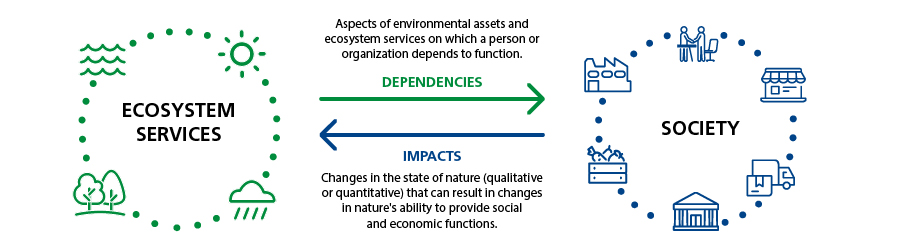
Fonte: Elaboração própria com base em TFND.
The TFND considers that impacts can be direct (a change in the state of nature caused directly by an activity – e.g., deforestation), indirect (a change in the state of nature caused indirectly by an activity – e.g., climate change resulting from GHG emissions), or cumulative (a change in the state of nature caused by the interaction of activities by more than one actor in the same location – e.g., a reduction in the population of a species due to various human actions, such as fishing, pollution, and other nature-degrading actions).
The TNFD (Taskforce on Nature-related Financial Disclosures) is a global, market-led initiative created in 2021 to expand the production and disclosure of nature-related financial information. It is possible that the TNFD recommendations, launched in 2023, will be incorporated into the Central Bank of Brazil's regulations for the national financial sector, as happened recently with the TCFD (Taskforce on Climate-related Financial Disclosures).
According to a 2023 PwC publication, more than 50% of global GDP is highly or moderately dependent on nature.
Among the twenty industries analyzed, five — representing approximately 12% of global GDP— have all of their direct operations highly dependent on ecosystem services. This means that ecosystem changes have the potential to eliminate the financial returns of these industries. These sectors include agriculture, forestry, fishing and aquaculture, food, beverage and tobacco, and construction.
Another 11 industries have at least 35% of the economic value of their operations or supply chain with high or moderate dependence on nature. In these cases, ecosystem changes can have a substantial impact on their financial results.
Furthermore, by analyzing 19 major stock exchanges, the study concluded that more than half of the market value of listed companies is subject to market risks, given their high or moderate dependence on nature.
Example: The automotive industry's dependence on nature throughout its value chain
 |
||
| Supply Chain | Manufacturing | Direct Customers |
| Raw material suppliers obtain wood, rubber, and other renewable natural materials from nature; mining companies use water to extract and refine the lithium used in electric vehicle batteries. | Manufacturers use water in manufacturing processes | Distribution and sales: Auto dealers rely on the natural regulation of rainfall absorption to protect themselves from flooding. |
| Associated Risks | Associated Risks | Associated Risks |
| Reputational risk associated with potential deforestation by timber suppliers and water shortages causing mining company operations to slow down. | Water shortages can increase manufacturers' operating costs. | A reduction in the natural regulation of rainfall absorption results in more frequent floods and increased service interruptions. |
Fonte: PwC
Nature-related opportunities, in turn, are activities that create positive impacts and/or mitigate negative impacts on nature, resulting in benefits for lifefor life, especially for people and organizations. Opportunities can arise from avoiding, mitigating or managing risks related to nature and the ecosystem services on which the organization and society depends, such as reducing the use of materials and energy in production, logistics, or consumption.
Opportunities can also emerge from transforming business models, products, services, markets, and investments with the aim of halting or reversing damage to nature—such as conservation, restoration and other nature-positive actions. These are even more impactful when nature-based solutions are adopted to obtain the goods and services offered, such as bioeconomy activities. And even more so when these actions include local, in what is known as the sociobioeconomy.
For companies, managing impacts on nature is no longer a matter of corporate social responsibility, it has become a strategic issue of risk management.
However, the importance of preserving biodiversity and nature goes beyond business. As we will explore in the next newsletter, a growing alliance between the public and private sectors is essential to transform our relationship with nature and protect biodiversity.
Biodiversity and the construction sector

Biodiversity and the sanitation sector
Impacts on biodiversity and planetary boundaries