We depend on biodiversity not only for our health and well-being— such as access to clean water, food, and medicine — but also for climate stability and economic growth. Our societies, economies, and financial systems are deeply interconnected with biological diversity, meaning their resilience and prosperity rely on the health of nature and ecosystems.
Biodiversity is the result of billions of years of evolution, shaped by both natural processes and human influence. The richness of terrestrial biodiversity is immense, and many species of fauna and flora have yet to be discovered.
According to the World Economic Forum, human activity has already degraded a third of the world's soil, destroyed more than 85% of wetlands, and 50% of the planet's coral reefs. Most of nature's contribution to human are not fully replaceable—and some are truly irreplaceable.
One of the greatest risks to humanity this decade, according to the 2020 World Economic Forum report, is biodiversity loss and ecosystem collapse. We need to do more.
Brazilian Biodiversity
Brazil is the country with the greatest biodiversity in the world. According to the Ministry of the Environment, there are more than 116,000 known animal species and more than 46,000 known plant species, distributed across six terrestrial biomes and three major marine ecosystems. These biomes are home to more than 20% of the world's total species, found both on land and in water.
Many of Brazil's species are native, and several of them are of global economic importance, such as pineapple, peanuts, Brazil nuts, cassava, cashews, and carnauba palms.
Brazil is also home to a rich sociobiodiversity. According to the Ministry of the Environment (MMA), there are more than 200 indigenous peoples and diverse traditional communities - such as quilombolas, riverside communities, caiçaras, and rubber tappers, among others- whose traditional knowledge is fundamental to biodiversity conservation and whose cultures are deeply rooted in a harmonious coexistence with nature.
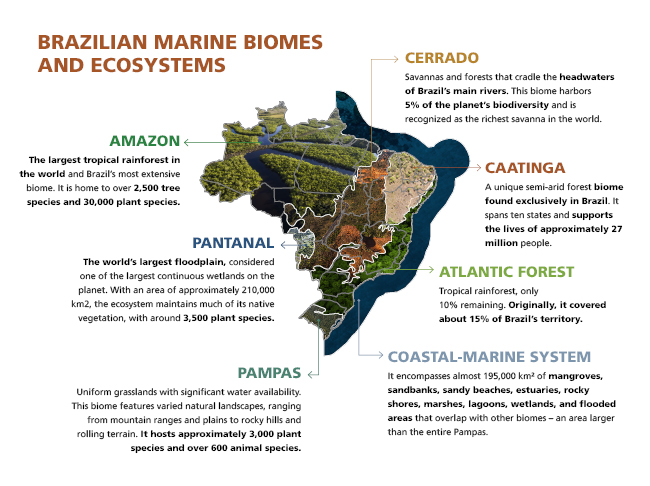
Brazil's biodiversity is not limited to the Amazon.
Two of Brazil's six terrestrial biomes are home to ecosystems considered biodiversity hotspots: the Atlantic Forest and the Cerrado. Brazil also boasts the world's largest continuous stretch of mangroves—1.3 million hectares—and the most extensive reef habitats in the Southwestern Atlantic, spanning 3,000 kilometers along the country's northeastern coast.
Why do we need to talk about biodiversity?
Nature is in crisis. According to a report by the Intergovernmental Science-Policy Platform on Biodiversity and Ecosystem Services (IPBES), the factors directly or indirectly driving environmental degradation have accelerated over the past fifty years. These include changes in land and ocean use, direct exploitation of organisms, climate change, pollution, and the invasion of exotic species. These direct drivers are themselves influenced by broader human behaviors, such as consumption and production patterns, population dynamics and trends, trade, and technological innovations.
In addition to direct risks to human health and survival, the Taskforce for Nature Financial Disclosure (TNFD) points out that this situation also creates risks for bussinesses, capital providers, financial systems, and economies—risks that are increasing in both severity and frequency.
The relevance of biodiversity to the economy can be seen in the importance of water availability for most activities, air quality for processes beyond production, and the existence of living species for the bioeconomy, from which most inputs are extracted, among countless other examples.
However, as previously noted, it is possible to conserve, restore, and sustainably use nature while simultaneously achieving other societal goals. To make this happen, we need urgent and coordinated efforts aimed at transformative change.