

Impacts on biodiversity and planetary boundaries
In this third post of the Biodiversity series, we will discuss what affects biological diversity and planetary boundaries.
Impacts on biodiversity and planetary boundaries
In this third post of the Biodiversity series, we will discuss what affects biological diversity and planetary boundaries.
Soil, oceans, freshwater, and the atmosphere are elements of nature that, together, provide us with a variety of renewable and non-renewable natural resources that generate a flow of benefits for humans – ecosystem services. Biological diversity, or biodiversity, is an essential and integral characteristic of nature and allows ecosystems to be productive, resilient, and capable of adapting.
Human actions impact nature. Depending on what we (individuals, companies, governments, and the financial system) prioritize, these impacts can be either negative or positive.
For example, by increasing greenhouse gas emissions, we may, on one hand, accelerate climate change. On the other hand, measures that encourage emission reductions, the reuse and recycling of materials (which slow down the rate of natural resource extraction), can generate positive impacts.
According to the Taskforce on Nature-related Financial Disclosures (TNFD), the main drivers of change that impact nature are: climate change; changes in land use, freshwater, and oceans; resource use and replenishment; pollution or its removal; and the introduction or removal of invasive exotic species.
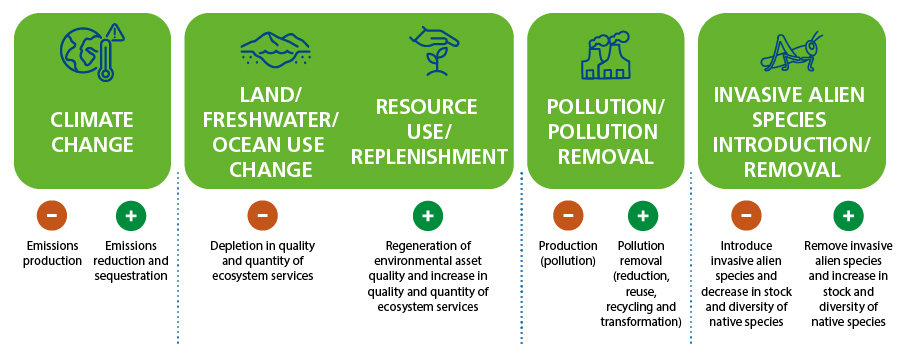
Source: Adapted from TNFD (2023).
Among the drivers that impact nature, climate change is one of the main direct causes of biodiversity loss. On the other hand, terrestrial and aquatic ecosystems are responsible for absorbing half of greenhouse gas emissions and therefore contribute directly to mitigating climate change.
The destruction of biome surfaces for agricultural activities and other land uses accounts for approximately 13% of total human CO₂ emissions, 44% of human methane emissions, and 81% of nitrous oxide emissions between 2007–2016, reaching 23% of total anthropogenic greenhouse gas emissions. Excessive emissions intensify and accelerate the effects of climate change (e.g., forest fires), which in turn impact biodiversity, potentially causing a decline in the size and condition of ecosystems, species extinction, changes in ecological communities, shifts in biomass, and deterioration of nature’s elements for communities and Indigenous peoples. This, in turn, affects the balance of nature and the Earth’s ability to absorb and capture greenhouse gases from the atmosphere, further increasing global temperatures.
When it comes to adapting to extreme events —such as severe droughts, heatwaves, and intense rainfall— which are becoming more frequent and intense due to climate change, biodiversity also plays an important role. The greater the diversity of species, the more resilient ecosystems are to these events.
The intense changes resulting from human actions over the past fifty years have significantly altered nature, leading to a loss of biodiversity that is accelerating and compromising the quality of life on the planet.
Some data from the World Economic Forum (2020) help illustrate the scale of biodiversity loss worldwide: 32% of forested areas and 50% of the world’s coral reef systems have been destroyed; more than 85% of wetlands have been lost and one-third of global soil is degraded; there has been an 83% decline in freshwater species populations; 41% of known insect species have declined in recent decades; and there has been a 60% decline in vertebrate species populations since 1970. Estimates suggest that 96% of all mammal biomass today consists of humans and livestock, while domestic chickens make up 70% of all bird biomass. If this trend continues, we may be heading toward the loss of half of all species by 2050, posing immeasurable risks to our future.
Moreover, the outlook for the future is concerning. If the planet’s temperature rises by 2°C above pre-industrial levels, it is estimated that one in every twenty species will be at risk of extinction, and more than 99% of coral reefs—which host over a quarter of all marine fish species—will be under threat.
Most of the vital ecosystem services that society depends on, and that form the foundation of all economic activities, are in decline. Continuing to view nature as an unlimited and free supplier of essential inputs will have irreversible consequences.
Research indicates that the global economy is already operating outside the safe zones for six of the nine planetary boundaries—a topic we will address next.
The “planetary boundaries” framework was proposed in 2009 by Johan Rockström from the Stockholm Resilience Centre, together with 28 other international scientists. The research emerged from the urgent need to create a socio-economic development model that considers the maintenance of the planet’s resilience and stability. The proposed framework allows us to monitor the impacts of human activities on the planet and identify when critical thresholds are exceeded.
In summary, nine critical “processes” were identified to ensure that the Earth system continues to function as it has for approximately the past 10,000 years. For each process, control variables and their respective boundaries (usually quantitative) were established. When indicators remain within these boundaries, we are considered to be in a “safe operating space” for humanity. Outside this safe zone lies the “zone of uncertainty,” where the risk of triggering large-scale abrupt or irreversible changes increases progressively.
The planetary boundaries defined in the model are:
In 2023, a team of scientists quantified, for the first time, all nine processes that regulate the stability and resilience of the planetary system. The study concluded that we have already exceeded six of the nine planetary boundaries: climate change, novel entities, biogeochemical flows, freshwater change, land-system change, and biosphere integrity.
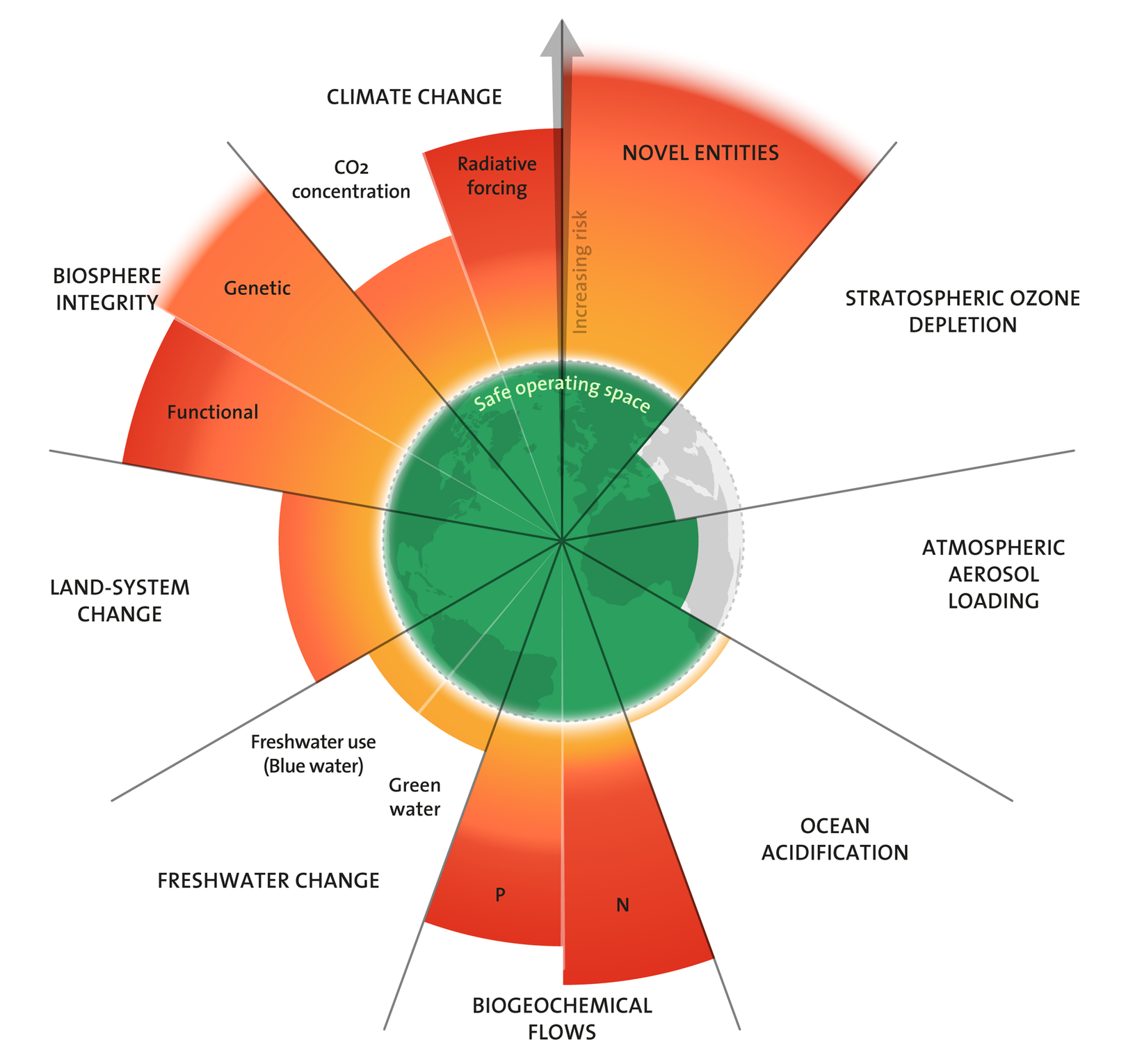
The 2025 update to the Planetary boundaries. Licensed under CC BY-NC-ND 3.0. Credit: "Azote for Stockholm Resilience Centre, based on analysis in Sakschewski and Caesar et al. 2025".
While it’s important to remember that these boundaries are interdependent—and crossing them, as we already have, can lead to large-scale abrupt or irreversible environmental changes—their establishment provides parameters for humanity to understand the limited time window available to adapt and take action.
The results of the model show that one of the most powerful ways to combat climate change and, consequently, reduce impacts on biodiversity is to restore forest cover to levels seen at the end of the 20th century. In other words, it is urgent that we prioritize actions capable of mitigating damage to nature, such as environmental-focused public policies, sustainable business and production practices, raising awareness of the risks and opportunities associated with nature conservation, and the preservation of cultural diversity itself.
Some concepts about biodiversity
Biodiversity and the construction sector
Biodiversity and the energy sector