A brief history of the biodiversity debate in Brazil and worldwide
The Convention on Biological Diversity (CBD) was signed by 150 countries during the United Nations Conference on Environment and Development (Rio 92). The goal of Rio 92 was to discuss the conservation and protection of terrestrial ecosystems in harmony with the promotion of sustainable development. The convention was created based on the recognition of the importance of biological resources—and biodiversity—for social and economic development, as well as the realization that threats to biological diversity had never been so significant.
Before the first Conference of the Parties (COP on Biodiversity) in 1994, the convention already had 168 signatories. Today, there are 196 member countries.
The convention is based on the principle that biodiversity goes beyond plants, animals, microorganisms, and their ecosystems: it’s about people and our need for food security, medicine, clean water and air, and a healthy environment in which to live.
The objectives of the convention are the conservation of biological diversity, the sustainable use of its components, and the fair and equitable sharing of the benefits arising from the utilization of genetic resources, including appropriate access to these resources, suitable transfer of relevant technologies (considering all rights over such resources and technologies), and adequate funding.
At the 10th Conference of the Parties to the Convention on Biological Diversity (COP 10), held in Nagoya, Japan, in 2010, a new strategic biodiversity plan was adopted and revised, with targets for the period from 2011 to 2020, known as the Aichi Targets—named after the Aichi Prefecture where the conference took place. At that time, countries were given two years to revise their strategies and action plans based on the targets.
Brazil’s biodiversity targets for 2011–2020 were defined in 2013, during the UN Decade on Biodiversity, and were published in 2017 as the National Biodiversity Strategy and Action Plan (EPANB).
In 2012, an independent international intergovernmental body was created: the Intergovernmental Science-Policy Platform on Biodiversity and Ecosystem Services (IPBES). Its purpose is to provide the scientific knowledge necessary to support decision-making and policy development in the fields of biodiversity conservation, sustainable use, human well-being, and sustainable development. Its creation was inspired by the Intergovernmental Panel on Climate Change (IPCC).
Intergovernmental Science-Policy Platform on Biodiversity and Ecosystem Services.
Today, 150 nations are part of IPBES, and a wide range of organizations, conventions, and civil society groups participate in its processes, along with various stakeholders—experts, representatives from academic and research institutions, local communities, and the private sector. These stakeholders contribute to and benefit from the platform’s work, which includes assessments, support for policy development, capacity building, and the creation and dissemination of scientific knowledge.
During the Decade on Biodiversity, in 2015, the Financial Stability Board—an international body that monitors and makes recommendations about the global financial system—created the Task Force on Climate-Related Financial Disclosures (TCFD) to enhance the production and disclosure of climate-related financial information, aiming to improve the financial market’s understanding of climate risks.
The recommendations for corporate disclosure were officially released in 2017. More recently, in 2021, the Taskforce on Nature-related Financial Disclosures (TNFD) was established, with its first recommendations published in 2023—the same year Brazil’s Securities and Exchange Commission (CVM) made it mandatory for publicly listed companies to align their reporting with TCFD guidelines through the adoption of the ISSB framework, which incorporates them. This demonstrates how the topic has become increasingly relevant not only for global leaders but also for companies, which must now consider climate and environmental risks in their financial analyses.
In 2022, at COP15, a new biodiversity framework was adopted, building on previous strategic plans and supporting the United Nations Sustainable Development Goals (SDGs). Known as the Kunming-Montreal Global Biodiversity Framework, its main goal is for humanity to live in harmony with nature by 2050. To achieve this, it outlines four overarching goals for 2050 focused on ecosystems and species:
- Halt human-induced species extinction;
- Promote the sustainable use of biodiversity;
- Ensure fair and equitable sharing of biodiversity benefits; and
- Reduce the biodiversity financing gap of $700 billion per year.
In this context, in May 2023, Brazilian Federal Government launched a public consultation to update the National Biodiversity Strategy and Action Plan (EPANB) based on the new global framework.
In June 2024, the National Bioeconomy Strategy was launched to coordinate and implement public policies aimed at developing the bioeconomy, in collaboration with civil society and the private sector. This strategy seeks, among other goals, to promote sustainable development by leveraging Brazil’s biodiversity to create products, services, and processes that integrate biological resources with new technologies.
The concept of bioeconomy
Decree No. 12,044, dated June 5, 2024, defines bioeconomy as “a model of productive and economic development based on values of justice, ethics, and inclusion, capable of generating products, processes, and services efficiently, grounded in the sustainable use, regeneration, and conservation of biodiversity, guided by scientific and traditional knowledge, as well as their innovations and technologies, aiming at value creation, job and income generation, sustainability, and climate balance.”
Bioeconomy is directly linked to ecosystem services and depends on biological resources, such as plants, animals, microorganisms, genetic resources, and biomass. In this way, it can be driven by nature-based solutions—and may even depend on them to some extent.
Examples of bioeconomy in Brazil
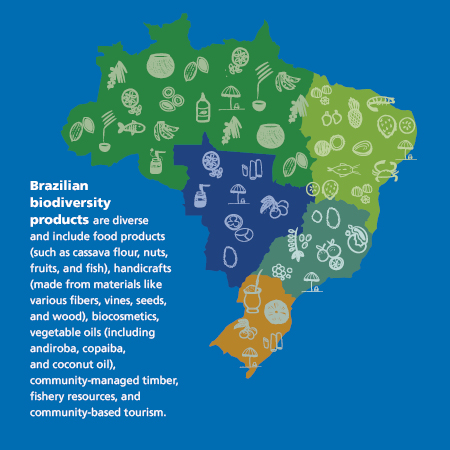
Brazil has enormous potential in the field of bioeconomy. A survey presented by ICMBio in 2019 cataloged the main sociobiodiversity products extracted and marketed by 128 community associations and cooperatives representing traditional peoples and communities from Sustainable Use Conservation Units. Although partial, this survey highlights the richness of Brazilian sociobiodiversity and the transformative potential that can be harnessed with justice, ethics, and inclusion.
Source: Adapted from ICMBio
Brazilian biodiversity products are diverse and include food products (such as cassava flour, nuts, fruits, and fish), handicrafts (made from materials like various fibers, vines, seeds, and wood), biocosmetics, vegetable oils (including andiroba, copaiba, and coconut oil), community-managed timber, fishery resources, and community-based tourism.
Examples of bioeconomy initiatives include: (a) in agriculture: sustainable agriculture (agroecology, regenerative agriculture, agroforestry systems, crop-livestock-forest integration), biofertilizers, aquaculture, and fishing; (b) in health: genetic mapping, bioinformatics, biomimetics, cosmetics, and fragrances; (c) in industry: biofibers, fabrics, bioplastics, biopolymers, pigments, and recycling; (d) in infrastructure: biofuels (as long as they do not lead to the conversion of native vegetation), social technologies for low-cost energy generation, and environmental restoration; (e) in tourism and culture: ecotourism, community-based tourism, handicrafts, bio-jewelry, and natural parks and museums.
Nature-based solutions: key concepts and examples
Nature-based solutions can directly contribute to the development of the bioeconomy.
According to the United Nations Environment Assembly (UNEA) definition from 2022, nature-based solutions are actions aimed at protecting, conserving, restoring, sustainably using, and managing terrestrial, freshwater, coastal, and marine ecosystems—whether natural or modified—that effectively and adaptively address social, economic, and environmental challenges, while also providing benefits related to well-being, ecosystem services, resilience, and biodiversity.
These solutions use or mimic natural ecosystems to deliver ecosystem services and contribute to climate resilience, food security, and overall well-being by reducing environmental and biodiversity degradation.
Stormwater and coastal parks: recreational spaces designed to flood during extreme weather events, helping to reduce heatwave effects and improve air quality.
Green roofs: absorb rainwater, reduce flooding, and improve air quality. They can also be used for growing food, lowering transportation costs and emissions.
Permeable pavements: allow rainwater to infiltrate the ground. They can be used along roadsides or in urban landscaping.
Rainwater harvesting: reduces stormwater runoff and decreases demand for potable water.
Urban tree planting: improves air quality, reduces heatwave effects, and mitigates stormwater runoff.
Ecological corridors: enable species movement and, when placed along waterways, help reduce flooding.
Fire management: includes prescribed burns and firebreaks in strategic areas to prevent wildfires in rural regions.